
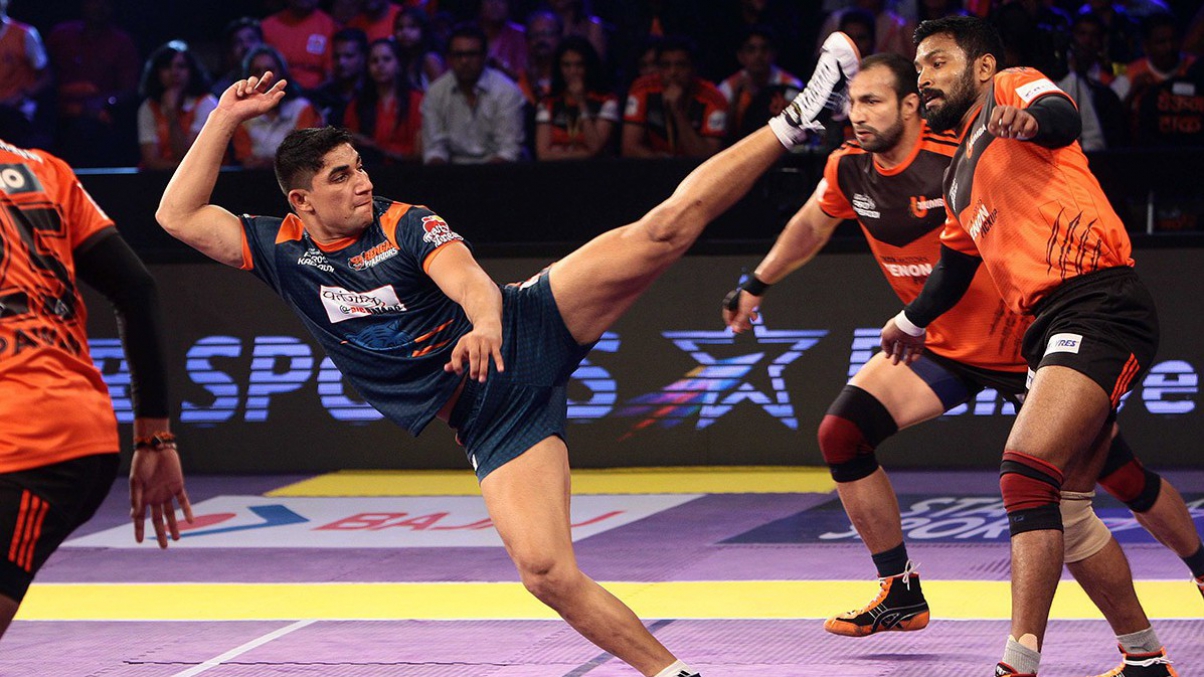
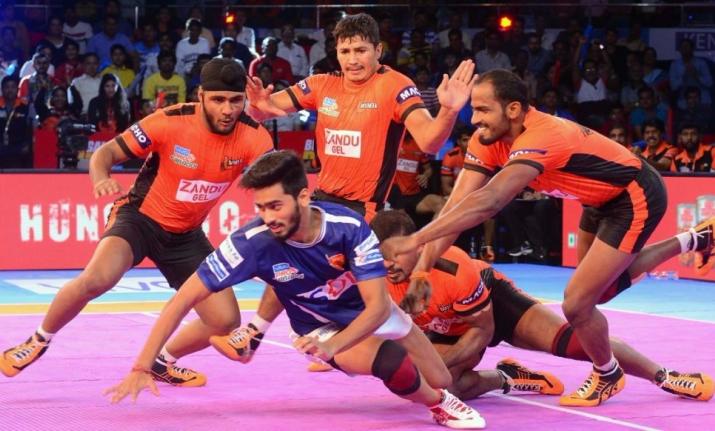
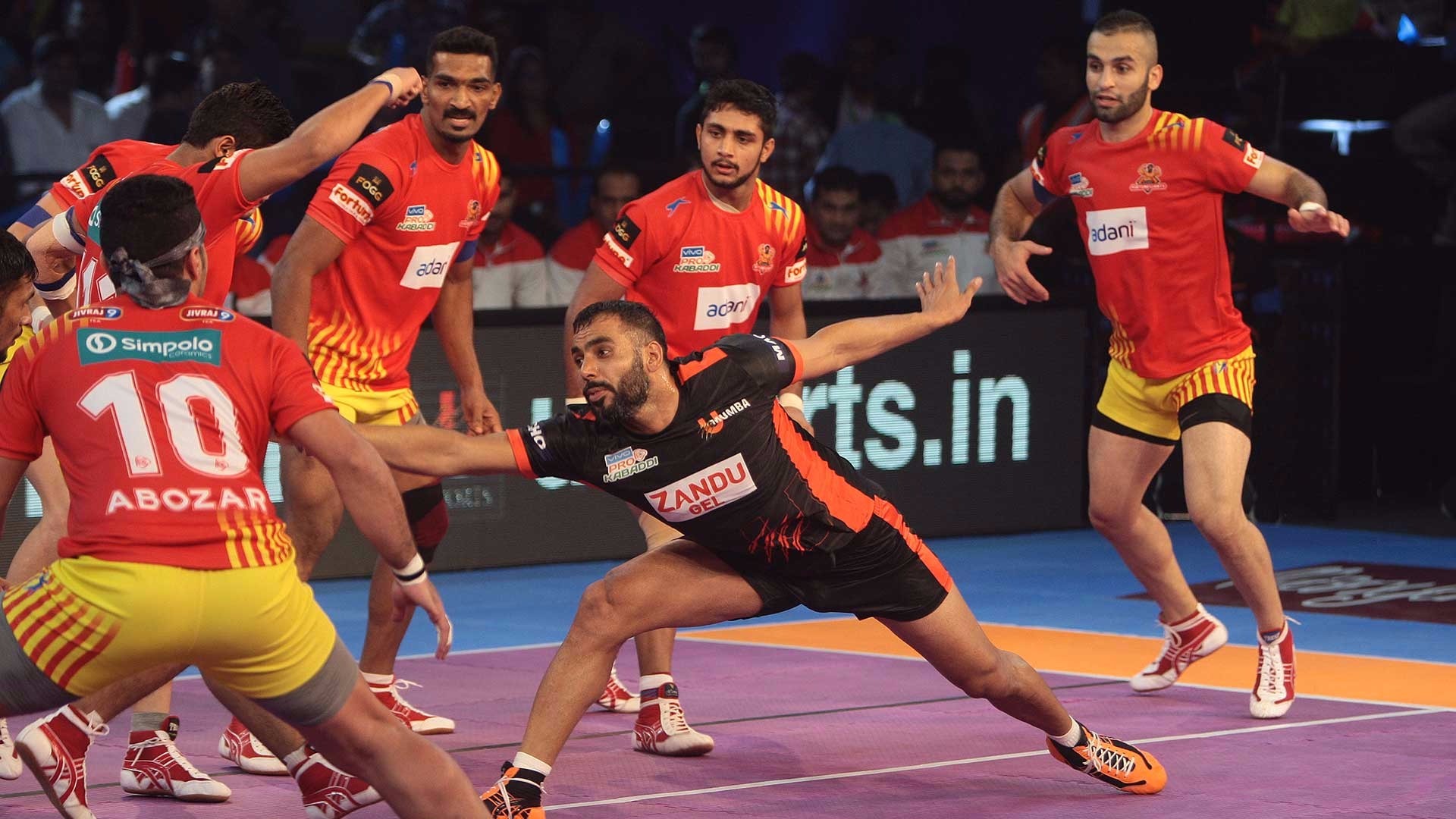
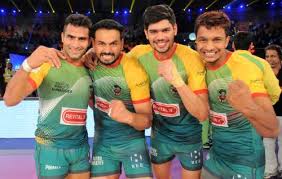
| A kabaddi match during the 2018 Asian Games. | |
| Highest governing body | International Kabaddi Federation |
|---|---|
| Nicknames | Kaudi, Pakaada, Hadudu, Bhavatik, Saadukuda, Hu-Tu-Tu, Himoshika, Sadugudu |
| Characteristics | |
| Contact | Permitted |
| Team members | 7 (per side) |
| Mixed gender | Yes, separate competitions |
| Type | Team sport, Contact sport |
| Equipment | None |
| Venue | Kabaddi court |
| Presence | |
| Country or region | Indian Subcontinent, Asia |
| Olympic | Demonstration sport: 1936 Olympics |
Kabaddi is a contact team sport. Played between two teams of seven players, the objective of the game is for a single player on offence, referred to as a “raider”, to run into the opposing team’s half of a court, tag out as many of their defenders as possible, and return to their own half of the court, all without being tackled by the defenders, and in a single breath. Points are scored for each player tagged by the raider, while the opposing team earns a point for stopping the raider. Players are taken out of the game if they are tagged or tackled, but are brought back in for each point scored by their team from a tag or tackle.
It is popular in the Indian subcontinent and other surrounding Asian countries. Although accounts of kabaddi appear in the histories of both ancient India and ancient Sistan, the game was popularized as a competitive sport in the 20th century by India. It is the state game of the Indian states of Andhra Pradesh, Bihar, Haryana, Karnataka, Kerala, Maharashtra, Punjab, Tamil Nadu, Telangana, and Uttar Pradesh. It is also the national sport of Bangladesh.[1]
There are two major disciplines of Kabaddi: Punjabi kabaddi, also referred to as “circle style,” comprises traditional forms of the sport that are played on a circular field outdoors, while the “standard style,” played on a rectangular court indoors, is a discipline played in major professional leagues and international competitions such as the Asian Games.
The game is known by its regional names in different parts of the Indian subcontinent, such as kabaddi or chedugudu in Andhra Pradesh, kabaddi in Maharashtraand Karnataka, Kerala and Telangana, hadudu in Bangladesh, bhavatik in Maldives, kauddi or kabaddi in the Punjab region, hu-tu-tu in Western India, hu-do-do in Eastern India, chadakudu in South India, kapardi in Nepal and kabaddi or sadugudu in Tamil Nadu.
History[edit]
Kabaddi, originated in ancient Tamil region Indian subcontinent, which is predominantly present day Tamil Nadu and parts of other South Indian states of India. Tamil empire spread this game to South East Asia during their sea trade. The word Kabaddi has been derived from the tamil word “kai-pidi” which means “to hold hands”.The exact of origins of Kabaddi are disputed, with theories suggesting that Kabaddi originated from either the Vedic period of ancient India, or the Sistan region of present-day Iran. The game was said to have been popular among the Yadava people, an abhang by Tukaram stated that the god Krishna played the game in his youth, while the Mahabharata contains an account of Arjuna being able to sneak into hostile areas and take out enemies unscathed—which parallels the gameplay of kabaddi. There are also accounts of Gautama Buddha having played the game recreationally. Despite these conflicting claims, India has been credited with having helped to popularize Kabaddi as a competitive sport, with the first organized competitions occurring in the 1920’s, their introduction to the programme of the Indian Olympic Games in 1938, the establishment of the All-India Kabaddi Federation in 1950, and being played as a demonstration sport at the inaugural 1951 Asian Games in New Delhi. These developments helped to formalize the sport, which had traditionally been played in villages, for legitimate international competition.[2][3][4]
 NEEL PEARL ACADEMY
